Since most domesticated pets are fed processed food and chlorinated
tap water, they probably have lost their natural taste for algae (see
Algae are Nature’s Unique
Superfood at the end). Here are suggestions for getting picky
cats and finicky dogs to accept algae products in their food:
- Open up a capsule and dip the end of a flat toothpick into the
long end of the capsule. Pull out whatever algae powder sticks to
the end of the toothpick (not heaping on the end of the
 toothpick) and mix that into your pet’s food. Do this every time you
feed a meal or fill the dry kibble container. After about 3-5 days,
and every 3-5 days thereafter, mix in an additional toothpick full.
Eventually you will be able to dump 1/4 capsule on top of the food
and just mix it up with a spoon. Use this toothpick method for dry
kibble, canned or raw food.
toothpick) and mix that into your pet’s food. Do this every time you
feed a meal or fill the dry kibble container. After about 3-5 days,
and every 3-5 days thereafter, mix in an additional toothpick full.
Eventually you will be able to dump 1/4 capsule on top of the food
and just mix it up with a spoon. Use this toothpick method for dry
kibble, canned or raw food.
-
Always start with just a pinch of powder
per meal and hold that amount for 3-5 days. If this amount is
accepted, then increase to two pinches per meal every 3-5 days
thereafter. You can mix the powder into any wet food in two ways:
a. Drop several small dots of powder on the food. Now cover up the
dots (without mixing) with more wet food.
b. Some pets like the powder mixed thoroughly in their food so that
the mixture is homogeneous and they cannot see or smell anything
foreign in their food.
Using this second method
may only get 1/4 capsule per day into your pet but that is better
than nothing. One has to give whatever the individual pet will
accept.
-
Try encapsulating the powder in ground
meat, soft bread, cheese, cottage cheese or any soft food.
- Some people have mixed the algae powder in
softened butter or milk.
- Most cats love the fishy odor and taste of another whole food
product called Seacure which is
pre-digested whitefish. Mix the algae
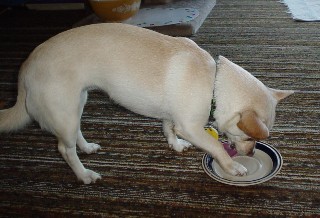 powder with the Seacure powder.
- Pet stores now carry a product called
Pill Pockets that you can put a capsule in. I do not know
how successful the cat version is but you can contact the company
and find out (size of pill pocket and success rate with cats). We
are not crazy about the wheat and corn in this product but the small
amount might be insignificant compared to the health value of the
algae.
- One can buy #3 or #4 size smaller capsules and transfer the
algae (coming in #1 size capsules) into these smaller ones for
pilling.
- One can literally dump the microalgae
powder from an open capsule into a pet's mouth.
- If all the above fails, one can always mix the
microalgae powder in
water and squirt it with a syringe or eye dropper several times per
day or But this is the most intrusive and least desirable
method.
Remember, for optimum results, it is best to
spread the total daily amount of powder equally over the entire day. For
example, for one capsule per day give ½-capsule in the morning and ½-capsule at night. For even better results, feed four ¼-capsule amounts
per day.
In some cases, the syringe method is absolutely needed. Here is a
testimonial from a vet:
 We
had a cat that came to our hospital that had not eaten in 4 days. All
lab tests and blood work were negative. Further examination found
absolutely nothing wrong with the cat but it was still dying. At the
suggestion of Russell Louie, owner of Optimum Choices, I gave the owner
some bio-algae concentrates and told him to mix it in water and squirt
it into the cat’s mouth. The cat started to eat and drink a little by
the end of the day. By the next day the cat was eating normally and
totally recovered. I never figured out what was wrong with the cat but
the owner was very thankful that the bio-algae concentrates literally
saved his cat’s life. We
had a cat that came to our hospital that had not eaten in 4 days. All
lab tests and blood work were negative. Further examination found
absolutely nothing wrong with the cat but it was still dying. At the
suggestion of Russell Louie, owner of Optimum Choices, I gave the owner
some bio-algae concentrates and told him to mix it in water and squirt
it into the cat’s mouth. The cat started to eat and drink a little by
the end of the day. By the next day the cat was eating normally and
totally recovered. I never figured out what was wrong with the cat but
the owner was very thankful that the bio-algae concentrates literally
saved his cat’s life.
Dr. Michael King, DVM
Canyon Animal Hospital
Here are some hints we have accumulated on opening up the capsules to
sprinkle the algae powder on pet’s food:
-
Make sure your hands are clean and DRY. If
the product is in a capsule, twist the two halves of the capsule to
break the heat seal.
-
Now gently separate the two halves of the
capsule by holding the long end at the bottom and pull the short end
of the capsule off the top. The short half will contain
approximately ¼-capsule while the long half will contain ¾-capsule.
-
Now rotate one of the capsule parts ¼ turn
until just a pinch of powder falls onto any wet food. Mix as
mentioned above in Step 2 (a. or b.) of the above list.
-
Gently put the two halves of the capsule
back together.
-
Store the partially used capsule in a
candy dish, bottle cap or tiny pill container for later use.
-
If some of the powder sticks to an ‘empty’
capsule at the end of usage, leave the two halves of the capsule
together but leave the whole capsule in a pill container for at
least 24 hours. After 24 hours, open up the two halves of the
capsule and knock together, pointing the open ends downward to
release the remaining powder in the capsule parts
Bio-algae concentrates
do not have to be refrigerated due to its superior freeze-drying
technology. Do not store
bio-algae concentrates near any heat source (for example, stove,
oven, and heat vent), microwave oven, computer monitor, TV, in direct
sunlight or leave in a hot vehicle.
The Kingdoms in Nature are:
- Bacteria (sometimes split into two Kingdoms)
- Protista (means the very first)—includes unicellular
(one-celled) and multicellular organisms, including algae, that are
not part of the Fungi, Plant or Animal Kingdoms)
- Fungi
- Plant
- Animal (herbivores, carnivores, omnivores, including human)
Nature is designed such that each Kingdom is dependent on the ones
below it. For example, ruminant animals (cows, sheep, goats, deer) would
not be able to survive without the bacteria in their rumen that digest
plant foods for them. They are actually eating fermented plant foods and
bacteria. Algae are organisms in the Protista Kingdom at the bottom of
the food chain. All beings (herbivores, carnivores, omnivores, including
human) are dependent on plants, fungi, algae and bacteria for
 survival.
Algae are literally a film that coats the Earth, in every natural body
of water and in the soil. Since algae are everywhere in nature, all
fungi, plants, animals and humans are designed to obtain certain
nutrients from algae (which contain over 5,000 individual nutrients).
When algae are lacking in their diet (as in the sanitized modern diet),
their health may suffer from the missing nutrients. Algae are Nature’s
most complete and original whole food for all species and serves as a
universal food for the plant and animal (including human) Kingdoms.
Algae are nature’s vitamin chest. survival.
Algae are literally a film that coats the Earth, in every natural body
of water and in the soil. Since algae are everywhere in nature, all
fungi, plants, animals and humans are designed to obtain certain
nutrients from algae (which contain over 5,000 individual nutrients).
When algae are lacking in their diet (as in the sanitized modern diet),
their health may suffer from the missing nutrients. Algae are Nature’s
most complete and original whole food for all species and serves as a
universal food for the plant and animal (including human) Kingdoms.
Algae are nature’s vitamin chest.
There are some algae nutrients that are particularly beneficial that are
hard to find from any other source. For example, Gamma Linolenic Acid
(GLA) is usually only found in early mother’s milk. GLA stimulates the
newborn’s immune system. So, how do adult animals get GLA if it needs to
stimulate its immune system? GLA is present in seeds of borage, black
currant, and evening primrose but how many animals (and humans) eat
those foods on a regular basis? The next largest whole food source (not
supplements) of GLA to mother’s milk is algae. There is no other food
that can nourish plants, herbivores, carnivores and omnivores like
algae. Algae occupy a unique role in the food chain for all plants,
animals and humans. No other food (and certainly supplement) can make
this claim. Algae are not just “pond scum.” By feeding
bio-algae concentrates, one
is literally giving super nutrition back to your pet that Nature
intended them to get in the wild.
|