Video on Russell's skepticism Freedom From Illness
After
our first two cats died of
kidney disease or
Chronic Renal Failure
(CRF) at age 17, we learned that grains are not an appropriate diet for
carnivores (meat-eating animals needing 60-90% meat). Chronic Renal Failure
(CRF) is almost an epidemic among older cats because so many people feed
dry kibble in free-feeders to their felines (unnatural for wild cats). Some holistic veterinarians say
kidney disease could almost be
prevented if cats were
not fed dry kibble all their lives. Dry kibble must
contain grains or other carbohydrates to hold it together during processing. At
most, premium brands contain only 50% meat (some new brands now claim 80%) and most (cheaper) brands are less than 30%. Upon
learning that, we transitioned our remaining cat to a grain-free
canned and
raw
food diet.
When we acquired our dog (needs 60-80% meat) we immediately put her
on a canned food diet and then transitioned her to raw food. Even the training
treats we give our dog are grain-free (we buy dried meat treats sold at natural
pet stores instead of dog “cookies”).
One reason to avoid grains is the
quality in most commercial pet foods is different than what you would cook for
your pet. Typically, the good quality grains go into human foods and what is
left over (unfit for human consumption) gets used in pet food. The grains
in pet food are more likely to contain toxic molds, pesticides and man-made
contaminants (such as melamine). Also, the plant protein in grains and
soy
in pet food gets counted towards the total protein of the food, though our pets,
as carnivores, can’t utilize it. They are designed to get their protein from
meat, not plants. The holistic veterinarian and pet food expert
Dr. Jean Hofve
recommends avoiding all non-meat protein sources. She states that
cheap
vegetable protein substitutes are inappropriate in the diet of a carnivore and
are used by the pet food companies only to increase profit.
From our holistic perspectives, based on
our research and according to many other holistic veterinarians, we do not
subscribe to the low-protein diet for chronic renal failure cats. This
low-protein diet myth was originally based on erroneous studies in the
1920-30's. The benefits of low-protein diets were never scientifically proven
but often accepted. Click this link to read what a vet has to say, Mythology of Protein Restriction for Dogs with Reduced Renal Function.
Most holistic vets now suggest feeding a high quality protein diet to chronic
renal failure cats. As CRF cats get pickier in their tastes, it is more
important to get good premium quality meat protein into their bodies, than worry
about any percentages.
It is especially important to avoid
grains with cats because they are “obligate carnivores” (must have meat to
survive). Their bodies are not designed to digest carbohydrates. Cats
need 70-90% meat (protein + fat) and cannot survive as vegetarians. Domestic
cats are descended from the African wild cat, whose natural diet was limited to
rodents, birds, eggs, reptiles and insects. This wild cat was domesticated by
the Egyptians 4,000 years ago to protect their granaries from rodents. The cat
was ideally suited to this task, since it did not eat grains. They
got their moisture from their food and not from
drinking water, as they lived in the desert. Their prey contains 65-75 percent
water. Cats do not have a strong thirst drive compared to other mammals so they
will not drink water until they are already dehydrated.
Yet today, most people feed their cats dry
kibble that contain more grains than meat and only averages 10 percent water.
Could this be why so many cats get kidney disease or Chronic Renal Failure
(CRF)? The new grain-free kibbles are not a solution either since they
lack water and the higher protein in them makes them even more dehydrating. They
still have a fattening starch in them such as potato or tapioca starch to hold
them together. The epidemic of obesity in our dogs and cats, which can
cause many health problems, is yet another reason not to feed our pets grains or
other starches (which are fattening to carnivores). Other health problems caused
by feeding dry kibble include urinary tract disorders and diabetes. One
holistic vet called dry kibble for cats “diabetes in a bag” and holistic vets
state that diabetes can often be cured by taking the cat off of dry food.
To learn more about the optimum diet for
cats (and dogs), see our e-Book
and the CD audio seminarHow NOT to Kill Your Cat
or Dogby Dr. Jean Hofve.
Dr. Jean Hofve recommends supplements high in Omega-3 fatty acids and
antioxidants for
cats with kidney disease. Not only does
bio-algae
concentrates have Omega-3 fatty
acids but it also contains Omega-6, Omega-9, GLAs (Gamma-Linolenic Acids), ALAs
(Alpha-Linolenic Acids), DGLA (Dihomogamma-Linolenic Acid), DHA (Docosahexaenoic acid) and more fatty acids. Just as important as these individual fatty acid
ingredients, is the fact that they are all in the proper proportions and dosages
that Nature intended animals to get. This is the
synergy found in whole food
products not present in isolated, extracted and man-made fatty acids
supplements. One can literally
imbalance the body further by
treating the symptoms with just an Omega-3 fatty acid supplement.
As far as antioxidants,
bio-algae concentrates
(Spirulina
pacifica, Spirulina platensis, Dunaliella salina and astaxanthin from
Haematococcus pluvialis) contain some of the world's most powerful: beta-carotene, alpha-carotene,
gamma-carotene, lycopene, lutein, beta-cryptoxanthin, zeaxanthin, and
astaxanthin. Astaxanthin has 500-1000 times the antioxidant capacity of
Vitamin E, greater anti-inflammatory capability than Vitamin E, 40 times
the antioxidant capacity of beta-carotene and almost 4 times the
antioxidant capacity of lutein. The antioxidants in bio-algae concentrates are so
good, we saw a mast cell cancer
tumor on a dog disappear in ten weeks using only 1.5 capsules/day.
Here are some case studies from
customers whose cats had CRF (Chronic Renal Failure) and used
bio-algae concentrates (Spirulina
pacifica, Spirulina platensis, Dunaliella salina and astaxanthin from
Haematococcus pluvialis).
If you have pets, here are some helpful suggestions our clients have sent us:
If you have heard that algae can be too strong, too harsh or too potent
(especially for cats) from other sources, please read our "wholistic"
perspective before ordering bio-algae concentrates. Go to our March, 2015,
newsletter article by clicking the green button below:
Just wanted to let
you know that Abby had her semi-annual blood work done last week and
the results were fantastic! As you know, she had been diagnosed with
chronic kidney disease, and the vet told me that she saw
no
evidence of kidney disease in the current blood work.
—B.K.
Chanda today: despite having been diagnosed with CRF, her numbers/ kidney values are stable, her
blood pressure is normal, eyes are clear, and clinically she literally has as
much energy and spirit as her earlier years, once again playing with her
toys and running through the house. She has such a soft and shiny coat that
everyone that meets her, whether a veterinarian, vet tech, stranger or friend
remarks about her soft coat! They simply cannot believe she is 20 yrs old!
— Kent
My 17 year old cat, Brindee, was diagnosed with CRF. Within a week, Brindee had more appetite, energy and was
more social than she's been in years! Two months later her Bun was down to 42,
Creatinine Clearance down to 3.4! My vet was very surprised to say the least.
— T. Collins
We gave this to our elderly cat that was dying of kidney disease
and saw an amazing improvement after just a couple of days on it. She
had more energy, more flexibility and was more like her “old” self.
—M.A.L.
Because of the amazing demand for our "wholistic"
consulting and revolutionary products,
we have to limit every inquiry (e-mail and telephone) to 15
minutes in order to help all those in need. After the first 15
minutes we charge our normal
consulting fee. Please
make use of all the free resources available 24 hours/day, by
clicking on the buttons in the left-hand menu of every product
page.
General questions and product
inquiries can take one week or more to answer. If we have not
responded to your e-mail or voicemail within one week, please
resubmit as these occasionally get lost in the 100-150 daily
requests we get. If you have an urgent need,
purchase one of the
Holistic Consultations.Satisfaction Guaranteed:
if you feel the holistic information is not of
value or you or your pet did not experience any benefits, we
will gladly refund your consultation fee.
Bio-Algae Concentrates Case Study 1—
Chronic Renal Failure (CRF)/Kidney
Disease
Chronic
Renal Failure (CRF)
or
kidney disease
is so prevalent in older cats today, this case study is so important from a
holistic perspective. Here is Kent's story:
It was nearly 17 years ago when I brought home 3 adorable Himalayan kittens:
Rocky, Kasey and Chanda. Rocky and Kasey littermates and Chanda had the same
father. For their entire lives I gave them the best care I knew of —
following the advice of a respected, well-established veterinarian clinic, I
gave them the highest quality food touted on the market like Iams and Hills
Science Diet and lots of TLC!
This past summer I learned the other side of pet ownership. In August 2006,
we learned Rocky had intestinal cancer and within 4 weeks he was gone. One week
later, I took Kasey in for a senior screening and learned he was in the advanced
stages of Chronic Renal Failure (CRF). [Sigh] Kasey did great, however, and for
4 months we enjoyed some of the best times of his life! He really was mostly
“normal” clinically right up until the day before his death on Dec 25th.
Amazing!
Several years ago I had done some extensive study as a non-practitioner in
the area of human nutrition, supplements, antioxidants and free radicals and
their role in various diseases, cancer, and the aging process. I had thought
because the cat food bag said “Antioxidants” on the outside I was giving them
proper nutrition. I had much to learn. I began searching the Internet for
information related to cancer and CRF in cats and found myself once again
learning volumes on the role that nutrition, lifestyle and antioxidants play in
life—only this time it was related to cats. I started with
Feline CRF
Information Center
which is absolutely fantastic and filled with so much practical and helpful
information! On their site I discovered
LittleBigCat.com
and the excellent work of Dr. Jean Hofve, DVM, who has turned her practice to
the extensive study of nutrition and lifestyle in cats. EVERY CAT OWNER NEEDS TO
STUDY THE INFORMATION ON HER WEBSITE!
Among the wealth of information I gleaned from Little Big Cat, two areas were
paramount. The importance of canned or wet food over dry food and bio-algae
concentrates for whole food supplementation.
I encourage you to read through the information on the above websites but here
is the short version of these two important points:
1. The
importance of canned or wet food (or even raw) over dry food—cats
are by nature arid (dry climate) animals and thus are designed by their Creator
to obtain the majority of their moisture from the foods they eat (i.e. birds,
mice, rats, etc.). Do the math—give your cats dry food and you are compounding
the dehydration factor which can lead to numerous health issues including but
not limited to CRF.
2. Bio-algae concentrates supplementation—I don’t sell the stuff so you
can put your guard down right away as this is not an attempt to sell you
anything. From what I have learned, cats, being obligate carnivores, do not have
the ability to break down the cell walls of plants thus it is probably a waste
of time to give them fruits & veggies. However, the bio-algae concentrates
are
unique in that cats are in fact able to process it and obtain an incredible
pallet of antioxidants, essential fatty acids (Omega 3, 6, 9 and GLA oils), over
4,000 enzymes, vitamins, amino acids, all known minerals and trace elements,
etc.
Quickly then to my remaining 16+ yr old cat, Chanda—just give her the canned
food with added bio-algae concentrates right? Wrong! As you know, cats are creatures of
habit and very finicky. They will not just switch foods or accept something new
thrown in. Dr. Jean Hofve has written an article suggesting how to go about
switching food
as well as one on
bio-algae
concentrates
I encourage you to read both.
What worked for Chanda: I continued to supply her with the dry food she
had been eating, and started putting the canned food out,
Life's Abundance’s Instinctive Choice formulated by holistic veterinarian,
Dr. Jane Bicks. I carefully
followed the suggestions of Russell Louie of Optimum Choices, LLC
where he suggested starting bio-algae concentrates with only the amount that will fit on
the end of a flat toothpick and gradually increasing another toothpick measure
every 3-5 days or so. It took five months of patience and persistence,
throwing a lot of food away, but I had made the commitment up front, realizing
that 83 cents per can of food plus an initial bottle of bio-algae concentrates was a small
price to pay even if I had to throw much of it away during the first few months
because Chanda’s health and vitality is worth it! If it needs to be a fresh can
each meal, who cares? Again, 83 cents a can is a small price to pay compared to
the cost of veterinary care. I used glass Pyrex storage containers for their
food and water bowls as well as food storage of the canned food. In doing so,
you avoid the risk of leaching contaminants from plastic or metal containers
into the food and supposedly the food tastes better to cats.
Chanda today: despite having been diagnosed with CRF, her numbers/kidney values are stable, her
blood pressure is normal, eyes are clear, and clinically she literally has as
much energy and spirit as her earlier years, once again playing with her
toys and running through the house. She has such a soft and shiny coat that
everyone that meets her, whether a veterinarian, vet tech, stranger or friend
remarks about her soft coat! They simply cannot believe she is nearly 19 yrs
old (2009)!
Please realize I am not suggesting that switching to canned food or adding
bio-algae concentrates are “miracle” cures and I am not a veterinarian. I am simply
letting you know what my experience has been, in the hopes you will get the same
or similar results with your pet! I know Chanda will not be with me forever—I
may have weeks, months, a year or at most several years given the average life
of a cat is 15-16 years but I want however much time she has to be as enjoyable
and healthy as possible. Whether the above is adding years to her life, I do not
know but I do know it is adding life to her years!
UPDATE (2010):
Hello – I wanted to let you know that Chanda is
celebrating her 20th birthday today!
Thanks so much to each of you for your priceless
contributions at making this possible! It all started
summer 2006 with Carol
from FelineCRF.com
where I was directed to LittleBigCat.com
after learning Chanda’s brothers had incurable “illnesses” where I began doing
some research on CRF, then wound up learning all kinds of valuable information –
from there wove my way to Russell with OptimumChoices.com
and in addition to learning about and getting Chanda on bio-algae concentrates
(and myself on BioSuperfood),
he also recommended Trilogy Instinctive Choice Cat Food at HealthyPetNet.com As you may recall it took
me 5 months to get her completely off of Dry Kibble Prescription Diet but worth
it all.
Amazing, after she was diagnosed 4 years ago as being in the early stages of CRF
(estimated 1-2± years remaining), she continues on to now past 20 years of age
and still strong, active, loving, and adorable. I realize that can change any
day at her age, but am taking and enjoying each special day – I continue to
attribute her condition in large part to getting her off dry kibble and onto a
really good wet food (Trilogy Instinctive Choice) as well as the bio-algae
concentrates and of course a great deal of TLC.
Chanda is alert, active, fun loving, not on any meds, and while I
realize neither she or I will live forever here on Earth, she has lived a very
full and healthy life that if it stopped today would still be grand – and we’ll
just take things one day at a time.
Thank you from both of us!
Cheers!
Kent
If you have heard that algae can be too strong, too harsh or too potent
(especially for cats) from other sources, please read our "wholistic"
perspective before ordering bio-algae concentrates. Go to our March, 2015,
newsletter article by clicking the green button below:
If you have pets, here are some helpful suggestions our clients have sent us:
My 17 year old cat, Brindee, was diagnosed with CRF in March. Her BUN was 48,
Creatinine Clearance 4.0. While researching treatment options I found bio-algae
concentrates and
ordered it immediately. Within a week, Brindee had more appetite, energy and was
more social than she's been in years! Two months later her Bun was down to 42,
Creatinine Clearance down to 3.4! My vet was very surprised to say the least.
That's when I told him about bio-algae concentrates. I am documenting Brindee's progress.
I am grateful I found bio-algae concentrates when I did. So impressed am I with this
product, I've added bio-algae concentrates to
my supplements and believe I will be able to reduce the number of individual
supplements I take daily, which in the long run will save me money.
T. Collins
Click on each page for Brindee's first blood test on 03/21/2007.
Click on page 1 for Brindee's second blood test on 06/02/2007.
It is significant to note that not only did Brindee's BUN
and Creatinine levels decrease by 11-15% in less than three months
but also many other critical values either increased or decreased as needed into
the normal range. Bio-algae concentrates are not given to make certain blood
values go up or down like allopathic drugs or even some
supplements.
Bio-algae concentrates simply supplies the body with super nutrition and lets the body
determine what is needed to heal. In this way, it is the genius of the body that
determines what should be increased or decreased to return to normal wellness
not the product doing the "healing."
BUN = 12.5% reduction
Creatinine = 15% reduction
Cholesterol = 11%
reduction
Na/K Ratio
decreased 14% into the normal range
WBC
increased 72% into the normal range
Neutrophils
increased 127% into the normal range
Lymphocytes
increased 18% into the normal range
Platelet count
increased 86% into the normal range
Bio-Algae Concentrates Case Study 3—
Chronic Renal Failure (CRF)/Kidney
Disease
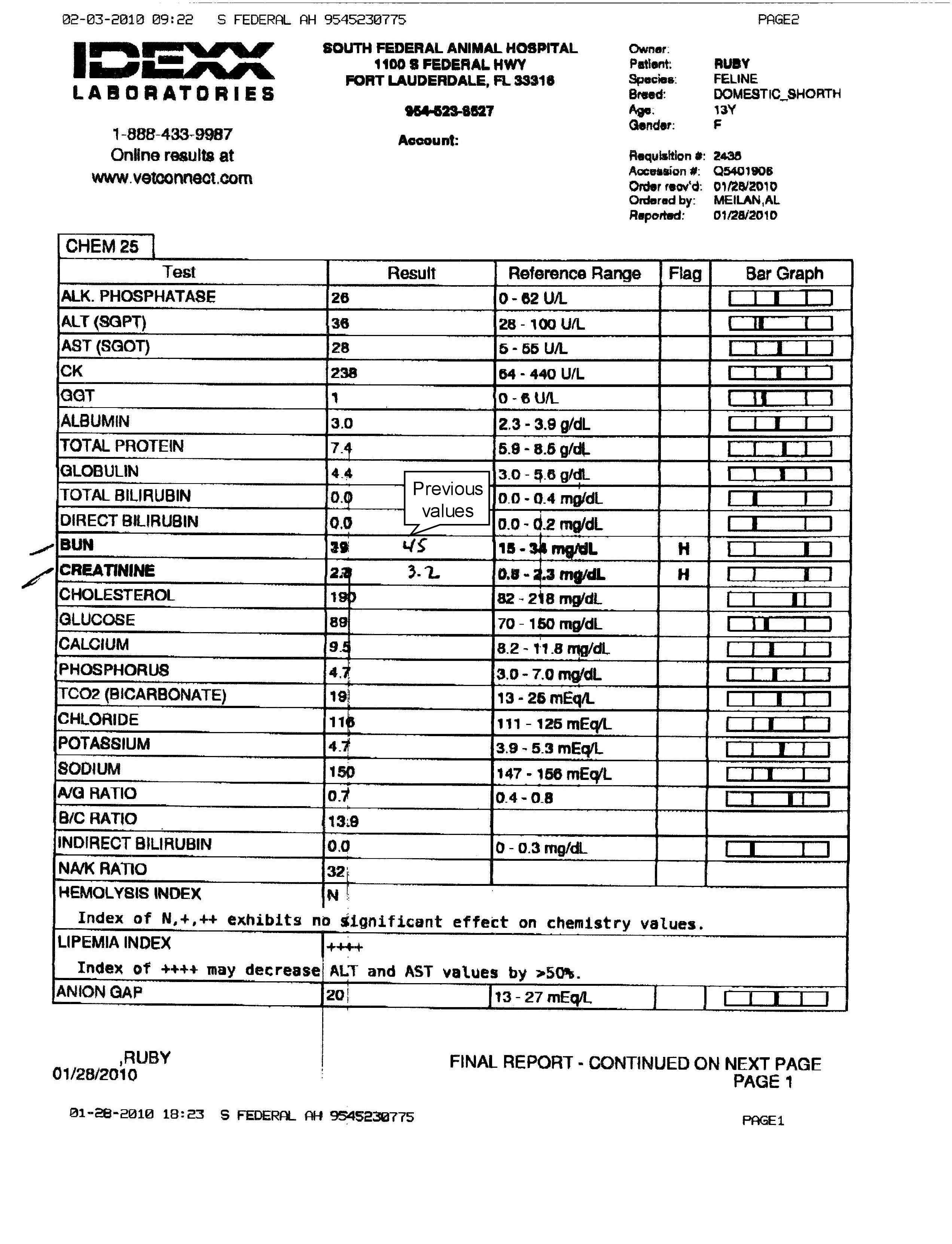
After only one month the BUN levels decrease from 45>39 and the
Creatinine decreased from 3.2>2.8.
Click on image to open PDF version
If you have pets, here are some helpful suggestions our clients have sent us:
If you have heard that algae can be too strong, too harsh or too potent
(especially for cats) from other sources, please read our "wholistic"
perspective before ordering bio-algae concentrates. Go to our March, 2015,
newsletter article by clicking the green button below:
A few years ago our cat Rob was diagnosed with kidney failure and needed saline
drips twice weekly. While it helped a bit, he used to vomit a lot. We started
feeding him bio-algae concentrates
which improved his condition a lot and reduced his vomiting. We also started him
on a raw food diet. Initially we needed two persons to feed him the pills, one
to hold him and one to force him to swallow the pill. Gradually, we got better
at it and only required one person. Eventually, he would come begging each
morning for his bio-algae concentrates pills and we just had to quickly pop it
in his throat with no struggle. That kept him alive for 3 years beyond
what he was expected to live but sadly he passed away a few months ago.
If we had known about the dangers of processed cat food earlier and had started
bio-algae concentrates earlier, perhaps he would still be alive today. We still
miss him dearly but we are glad that at least he lived more than he was expected
to live.
Motivated by the success with Rob, we are now trying BioSuperfood on ourselves for
various symptoms.
—R.C.
If you have heard that algae can be too strong, too harsh or too potent
(especially for cats) from other sources, please read our "wholistic"
perspective before ordering bio-algae concentrates. Go to our March, 2015,
newsletter article by clicking the green button below:
If you have pets, here are some helpful suggestions our clients have sent us:
Dr. Michael Kiriac,
the inventor of bio-algae concentrates, says chronic renal failure is a
degenerative disease that starts in the brain. By the time symptoms show up in
the kidneys, the disease is in the advanced stages. Therefore, the animal
needs the most advanced algae product with the highest antioxidants and super
nutrition to support the glands in the brain (not the kidneys).
The high antioxidants will help the body compensate for the lack of kidney
function. The super nutrition will literally wake up the master gland
and organs
in the brain (specifically the hypothalamus gland). This latter point is what
can help the body deal with chronic renal failure directly rather than just supplementing the
kidneys with a vitamin pill for maintenance.
How did bio-algae
concentrates do all this? Bio-algae concentrates simply supplied
the body with nutrients of Vitamin A, B-complex, C, D, E and K,
essential fatty acids of Omega 3, Omega 6, Omega 9, Gamma Linoleic Acid
(GLA content is similar to early mother's milk),
Alpha-Linolenic Acids (ALAs), Dihomogamma-Linolenic Acid (DGLA), Docosahexaenoic acid (DHA) and more fatty acids, over
4,000 enzymes, 10 essential amino acids plus 10 non-essential ones, all known trace minerals
and elements, antioxidants, phytonutrients, polysaccharides and thousands of other nutrients so the body
could resume normal healthy function. Bio-algae concentrates did not
treat the symptoms but holistically balanced the whole body. When the
endocrine and immune systems are holistically balanced, everything will work
like it should. Bio-algae concentrates are so revolutionary they are
100 years ahead of their time. Now
that’s true holistic wellness!
These results are individual case studies. We cannot
guarantee your results will be the same. Since each body
responds differently to the super nutrition in bio-algae concentrates your
results will be different. These statements have not been evaluated by the FDA.
This information is not intended to diagnose, treat, cure or prevent any
disease.
If you are still not convinced
about the holistic potential of
bio-algae
concentrates,
please click the button below:
If you have pets, here are some helpful suggestions our clients have sent us:
If you have heard that algae can be too strong, too harsh or too potent
(especially for cats) from other sources, please read our "wholistic"
perspective before ordering bio-algae concentrates. Go to our March, 2015,
newsletter article by clicking the green button below:
Give your beloved pet the health it deserves
and the longevity you desire with One Holistic Solution
Because of the amazing demand for our "wholistic"
consulting and revolutionary products,
we have to limit every inquiry (e-mail and telephone) to 15
minutes in order to help all those in need. After the first 15
minutes we charge our normal
consulting fee. Please
make use of all the free resources available 24 hours/day, by
clicking on the buttons in the left-hand menu of every product
page.
General questions and product
inquiries can take one week or more to answer. If we have not
responded to your e-mail or voicemail within one week, please
resubmit as these occasionally get lost in the 100-150 daily
requests we get. If you have an urgent need,
purchase one of the
Holistic Consultations.Satisfaction Guaranteed:
if you feel the holistic information is not of
value or you or your pet did not experience any benefits, we
will gladly refund your consultation fee.
If you
still have questions, here are some
more resources.
Click the logo on the left, for free answers to quick questions.
In order
to better serve all our customers, if your particular situation requires more
than a quick 5-10 minute answer, we suggest a Holistic Consultation.
Click the link on the left, for a more lengthy
paid holistic consultation.
Nothing on this website has been evaluated by the FDA. This information
is not intended to diagnose, treat, cure or prevent any disease. Please
see a qualified healthcare practitioner for any disease or illness.



















 summer 2006 with Carol
from
summer 2006 with Carol
from