 |
|
|
|
|
| |||||
|
|
Optimum ConnectionsNews from Optimum Choices, LLCWelcome to the October 2007 edition of Optimum Connections, the monthly e-newsletter from Russell Louie and Margaret Auld-Louie at Optimum Choices, LLC. This newsletter is sent to the friends and customers of Russell & Margaret as well as people who signed up for a drawing at our booth at a fair or event. If you wish to unsubscribe, see the bottom of this e-mail for instructions. To receive this newsletter in your e-mail, click here. Contents
October Sale
|
|
©2005 Essential Science Publishing. The information in this article is
from the Essential Oils Desk Reference, which can be ordered here: Click here to order on our Young Living World Essential Oils website. Click on Product Catalog, then pull down the menus Essential Oils/Blends A-M and do a [Product Search] on En-R-Gee, or call us at (303) 271-1649 or (866) 305-2306 (toll-free). |
These statements have not been evaluated by the Food and Drug Administration. This product is not intended to diagnose, treat, cure, or prevent any disease.
 In case you were wondering why we are no longer pleading for a home for Cajun
(the Hurricane Katrina cat) in our monthly newsletters, it's because we adopted
him ourselves. After more than a year of fruitlessly trying to find him a home
(listing in our newsletter, posting on our website, handing out flyers at shows,
posting him on Craig's list, etc.), we decided to adopt him ourselves, along
with his companion cat, Asher. We had not considered adopting him previously
because it would have been too stressful for our elderly cat,
Connie, to adapt to
new cats in the household. However, Connie finally succumbed to
kidney failure
at the end of July this year, at the ripe old age of 23. Russell was looking
forward to a cat-free hiatus so he could focus on running Optimum Choices, after
serving as a cat nursing home for 3 elderly cats over the past 10 years.
But fate had other plans for us. When Margaret inquired about the status of
Cajun and Asher, she learned that their foster parents would soon be traveling
extensively, leaving them home alone (while their dog went to a friend's
house). So, the cats would be very lonely and the foster parents hoped they
could find another home where the owners would be available for the cats.
In case you were wondering why we are no longer pleading for a home for Cajun
(the Hurricane Katrina cat) in our monthly newsletters, it's because we adopted
him ourselves. After more than a year of fruitlessly trying to find him a home
(listing in our newsletter, posting on our website, handing out flyers at shows,
posting him on Craig's list, etc.), we decided to adopt him ourselves, along
with his companion cat, Asher. We had not considered adopting him previously
because it would have been too stressful for our elderly cat,
Connie, to adapt to
new cats in the household. However, Connie finally succumbed to
kidney failure
at the end of July this year, at the ripe old age of 23. Russell was looking
forward to a cat-free hiatus so he could focus on running Optimum Choices, after
serving as a cat nursing home for 3 elderly cats over the past 10 years.
But fate had other plans for us. When Margaret inquired about the status of
Cajun and Asher, she learned that their foster parents would soon be traveling
extensively, leaving them home alone (while their dog went to a friend's
house). So, the cats would be very lonely and the foster parents hoped they
could find another home where the owners would be available for the cats.
Cajun had first come to Denver in September 2005, rescued from a Louisiana shelter after Hurricane Katrina along with numerous other cats and dogs by the Misha May Foundation. Margaret worked extensively with the Misha May Katrina cats that fall, helping find them medical care and homes. With Cajun being only 6 months old, he quickly found a home with a vet tech at one of the hospitals that treated the Katrina cats. However, the tech's living situation changed the following July and she had to surrender him along with her existing 5 year-old cat Asher, a gray tabby. Having worked with the Katrina cats, Margaret was very dismayed when Cajun lost his home and hoped to find him a new one soon. But finding adult cats homes that are not on display in a shelter, where lots of people can visit with them, can be quite difficult. When there was no interest by January of this year, Margaret posted Cajun on Craig's list but the only response was someone wanting to know "what was wrong" with Cajun that he had not found a home yet. Well, there was nothing wrong with Cajun except that he was no longer a cute little kitten, which is what most people prefer to adopt (as Margaret can attest to from her work at Cat Care Society as a volunteer adoption assistant). So, it only made sense to consider adopting Cajun & Asher after Connie passed on, since they had been in foster homes for more than a year at that point.
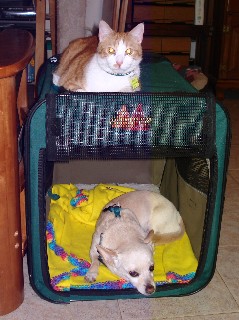 At our preliminary visit to the foster home, we took our dog,
Mikki, to gauge the
chemistry between the species. As Mikki usually does, she treated the cats like
furniture and ignored them. Mikki was more interested in asserting herself by
growling at their dog. So, with compatibility reasonably assured we agreed to
become the permanent guardians of two more cats. After we arrived home with the
cats, Mikki's whole attitude changed. The cats, with typical curiosity, were
investigating and sniffing everything in our house. When they got to Mikki's
camper tent or one of the many pet beds in our home, Mikki became aggressive
and chased the cats off. Another unexpected phenomena was that the older cat,
Asher, whom we renamed Iris, was so stressed out by the move her nerves were constantly on edge. She
started hissing every time her housemate, Cajun, came too close. (In her
previous homes, she had been close to Cajun, as you can see from the picture
above of her snuggled up next to him.) Because Mikki
had lived with cats and basically ignored them, we didn't feel the normal
routine of initial separation as a way of introducing new pets into a household was
necessary. So, now we had an aggressive dog and hissy cat on our hands.
At our preliminary visit to the foster home, we took our dog,
Mikki, to gauge the
chemistry between the species. As Mikki usually does, she treated the cats like
furniture and ignored them. Mikki was more interested in asserting herself by
growling at their dog. So, with compatibility reasonably assured we agreed to
become the permanent guardians of two more cats. After we arrived home with the
cats, Mikki's whole attitude changed. The cats, with typical curiosity, were
investigating and sniffing everything in our house. When they got to Mikki's
camper tent or one of the many pet beds in our home, Mikki became aggressive
and chased the cats off. Another unexpected phenomena was that the older cat,
Asher, whom we renamed Iris, was so stressed out by the move her nerves were constantly on edge. She
started hissing every time her housemate, Cajun, came too close. (In her
previous homes, she had been close to Cajun, as you can see from the picture
above of her snuggled up next to him.) Because Mikki
had lived with cats and basically ignored them, we didn't feel the normal
routine of initial separation as a way of introducing new pets into a household was
necessary. So, now we had an aggressive dog and hissy cat on our hands.
Since Connie had passed over the Rainbow Bridge just a few weeks previously, we found we missed her even more when we got new cats, as they were strangers to us. We had lived with Connie for 17 years. Bonding to a little kitten or puppy is relatively easy for people, since they are so cute looking and their infantile appearance triggers us biologically to nurture them. With adult animals, it can be a different story, taking time to connect with them. Margaret remembers that when we got Mikki (our dog), it took about a week before Margaret was attached enough to Mikki not to second-guess her decision to get her (since Connie was reacting poorly to having a dog in the house and Mikki was being extremely clingy). Now she can't imagine loving any dog more than she loves Mikki but at the beginning, it took some time to bond with her and Margaret sympathized with a friend who had gotten a cat years before from Cat Care Society and then didn't want the cat the first week or so. Now, we were going through conflicting emotions again, having disrupted our peaceful household with a pair of cats that were reported to be attached to each other but were not getting along. The cats had been in their last foster home so long (since before Christmas) that they were upset to be moved to a strange house with strange people, unlike a shelter animal that would be grateful to be in any house. Also, instead of a calm, elderly black lab (in their foster home), they had to contend with a little Chihuahua mix that was trying to drive them away.
 So, it was not the perfect situation for the cats but they needed a permanent
home and with Russell working from home, they would have lots of human
companionship. We quickly realized that we would have to be patient and modify
our expectations (Margaret's dream had been to get a pair of cats that had
always lived together and got along perfectly, ideally black cats, her
favorite). With Mikki attacking them, we had to shut her away from the cats
(thank goodness for baby gates) or keep her on leash in the house when they were nearby.
After a couple of weeks of doing that, Mikki improved enough that we could let
her loose with the cats and she has continued improving with time. Now, she only
attacks them on occasion when she is competing with them for food (in the
kitchen). If she gets too aggressive, she gets a "time out" in her camper and
that calms her down. Otherwise, she mostly ignores the cats as she does with
most cats.
So, it was not the perfect situation for the cats but they needed a permanent
home and with Russell working from home, they would have lots of human
companionship. We quickly realized that we would have to be patient and modify
our expectations (Margaret's dream had been to get a pair of cats that had
always lived together and got along perfectly, ideally black cats, her
favorite). With Mikki attacking them, we had to shut her away from the cats
(thank goodness for baby gates) or keep her on leash in the house when they were nearby.
After a couple of weeks of doing that, Mikki improved enough that we could let
her loose with the cats and she has continued improving with time. Now, she only
attacks them on occasion when she is competing with them for food (in the
kitchen). If she gets too aggressive, she gets a "time out" in her camper and
that calms her down. Otherwise, she mostly ignores the cats as she does with
most cats.
Cajun has been a delightful cat from the beginning. Margaret calls him the "Golden Retriever" of cats because he has the friendly, calm, happy demeanor of a Golden Retriever and loves all people. He is even orange like a Golden Retriever (orange striped tabby with white). He is also extremely playful and wakes us up in the morning wanting to play. Iris is still hissing at Cajun whenever he gets too close or tries to play, despite various flower remedies that we have tried. It saddens us that she won't play with Cajun, who desperately wants a playmate. But otherwise she is becoming at home, and especially enjoys eating grass we grow for her as well as sitting in the windows watching the outside world. We don't let the cats outside loose, as it would not be safe for them, particularly Cajun, who was declawed by the previous vet tech owner. Iris had been an indoor/outdoor cat and loves going out so much that she doesn't object to being put on a harness and leash to go outside (often cats will object to wearing harnesses). We are finding we have to be very patient with her, as she slowly warms up to us and gets used to her new home. We can see now why some adopted animals get returned, due to the owners being disappointed when the animals don't immediately fit into their household.
Feeding the cats has also been a challenge. In their foster home, the cats were left to free-feed on dry kibble, as well as given supplementary canned food. Most foster cats are cared for that way. We have learned that dry kibble is bad for cats, as is free-feeding them, so we immediately changed to meal feeding them canned food. Both cats were overweight from the constant kibble and Iris' coat was dry and "yukky" feeling. It seemed that Iris was particularly addicted to kibble because it was difficult to get her to eat any canned food. She would only eat canned tuna cat food at first, which is not particularly good for cats. Pet nutrition expert Dr. Jean Hofve states that fish is bad for cats. However, she also states that cats can and will starve themselves to death rather than eat something they don't want. So, we had to give Iris what she would eat, which was premium cat food tuna (note: don't give your cat human canned tuna, which has no added vitamins to balance it). We bought all the flavors of premium canned cat foods in local stores and posted a chart on our refrigerator where we could record who would eat what (including Molly, the outdoor neighborhood cat we feed, who is finicky due to getting "junk food" cat food from the neighbors). While Cajun would eat many varieties, Iris would only eat fish flavors. We also immediately started adding BioPreparation algae to their diet and were gratified to notice Cajun's coat get soft and silky after just one week on it (BioPreparation has all the important essential fatty acids, i.e., Omega 3, 6 and 9, as well as the rare gamma linoleic acid oil.) It took Iris' coat longer to improve; her coat was very dry and coarse feeling initially.
 After about a month they had both slimmed down and adjusted to meal feeding,
though we sometimes give them more than 2 meals if they don't eat much at a
meal. We began trying some pre-made frozen raw cat food and to our surprise,
Iris would eat the frozen chicken patties (Nature's Menu chicken patties for
dogs and cats). Cajun would also eat the chicken, as well as the turkey flavor.
Later we tried raw rabbit which they would eat if mixed with some yummy canned
food. Cajun also ate raw goat but apparently had too much as he threw it up
later. Switching the diet of our pets can be tricky as their digestive systems
have to adjust to the change. Having taken a year to switch our elderly cat
Connie to raw food 5 years ago, we were very pleased to get our new cats to eat
some raw food after just a month. It seems that the younger the cats are, the
easier they are to switch (and it's easier on their bodies as well). But even
with young cats, patience is required. It's not like a dog where you can just
put down a bowl of anything and they'll scarf it up. Sometimes the cats will eat
100% raw and other times we have to add canned food to it for them to eat it.
Their whims change from meal to meal.
After about a month they had both slimmed down and adjusted to meal feeding,
though we sometimes give them more than 2 meals if they don't eat much at a
meal. We began trying some pre-made frozen raw cat food and to our surprise,
Iris would eat the frozen chicken patties (Nature's Menu chicken patties for
dogs and cats). Cajun would also eat the chicken, as well as the turkey flavor.
Later we tried raw rabbit which they would eat if mixed with some yummy canned
food. Cajun also ate raw goat but apparently had too much as he threw it up
later. Switching the diet of our pets can be tricky as their digestive systems
have to adjust to the change. Having taken a year to switch our elderly cat
Connie to raw food 5 years ago, we were very pleased to get our new cats to eat
some raw food after just a month. It seems that the younger the cats are, the
easier they are to switch (and it's easier on their bodies as well). But even
with young cats, patience is required. It's not like a dog where you can just
put down a bowl of anything and they'll scarf it up. Sometimes the cats will eat
100% raw and other times we have to add canned food to it for them to eat it.
Their whims change from meal to meal.
So, we have learned that we have to be patient with our new charges as they adjust to a new environment and new food. If you adopt a new pet expecting them to immediately fit into your household, you are setting yourself up for disappointment. Perhaps that is why some adopted animals get returned--they don't fit in quickly enough to their new home. But each time they get returned, they may take longer to adjust to the next new environment. It's traumatic for a pet to be re-homed. So, if you adopt a new pet, we encourage you to be patient and give them time to adjust and yourself time to bond with them. We have used the advice we learned from Lorraine May, of the Misha May Foundation, who offers holistic, positive dog training classes, as well as Dr. Jean Hofve, who offers cat behavioral counseling in addition to nutritional advice.
 |
Click here
to give your pet |
 |
General Information: Russell@OptimumChoices.com
Webmaster:
Webmaster@OptimumChoices.com
Newsletter Editor, Margaret Auld-Louie:
Editor@OptimumChoices.com
303-271-1649
866-305-2306 (toll-free)
Normal office hours are 11:00 AM – 7:00 PM Mountain Time (U.S.). If you would
like a return call outside those hours, please specify what days and times are
best.
416 Plateau Pky
Golden, CO 80403-1533
U.S.A.
|
|